Furusato Nozei in English: Gifts for a Net ¥2,000
Quick Answer: Furusato Nozei (ふるさと納税) lets you donate to a Japanese municipality of your choice in exchange for a local gift worth ~30% of your donation. The donation reduces next year's resident tax — if you stay within your cap, your real cost is ¥2,000. You're eligible as long as you pay Japanese resident tax. Most major portals (Furusato Choice, Satofuru) have English support. Deadlines are December 31 for the donation and January 10 for the One-Stop Tax Exemption form.
Furusato Nozei is one of the more useful tax programs available to residents of Japan — but most foreign professionals either don't know about it or assume it's not for them. Both assumptions are wrong.
This guide explains how the program works, the application process step by step, the calendar to follow, and how to think about whether the program actually fits your financial picture. It's written for international residents in Japan who pay resident tax and want to understand the program from first principles, not from a Japanese-language portal that assumes you already know how the tax system works.
It's educational only — not tax advice. For your specific situation, consult a Japanese tax professional or your municipal office.
What Furusato Nozei Is, in Plain Terms
Furusato Nozei translates literally to "hometown tax donation." The official policy goal is to redirect tax revenue from Tokyo and other major cities toward rural municipalities — places that have lost population and tax base over decades. As a participating taxpayer, you donate to a municipality of your choice (it does not need to be your literal hometown — any municipality in Japan is eligible) and the donation is treated as a deduction against the following year's resident tax.
The mechanism that makes the program popular is the return gift. By national regulation, participating municipalities can offer a local product as a thank-you for your donation, up to approximately 30% of the donation amount in market value. Rice, premium beef, regional fruit, sake, household goods, vouchers, travel experiences — the catalog is enormous, with tens of thousands of options listed on the major portals.
The arithmetic that makes it attractive: if you stay within your annual cap, your actual out-of-pocket cost is fixed at ¥2,000 regardless of how much you donate. So a ¥30,000 donation costs you ¥2,000 net (¥28,000 returns as tax credits in the following year) and produces a gift estimated at around ¥9,000 in market value. The same math scales: a ¥100,000 donation within your cap still costs you ¥2,000 net and produces about ¥30,000 of gift value.
Over-donating beyond your cap is the most expensive mistake in the program. Donations above your cap lose the tax credit, so the excess becomes a direct cost. Your cap depends on income, household composition, and other deductions — which is why estimating it carefully matters before you donate. Our free Furusato Nozei Simulator gives you an estimate using the 2024–25 reference table.
How Does Furusato Nozei Actually Work?
The flow from donation to tax credit takes about 12–15 months from start to finish, but the user-facing work is small.
1. Choose a municipality and a gift. Most foreigners use one of the major portals — Furusato Choice, Satofuru, Rakuten Furusato Nozei, or Furunavi. All of them have at least partial English support. You browse by region, by product category (rice, meat, seafood, fruits, travel vouchers, daily goods), or by donation amount. You can split your annual cap across multiple municipalities — there's no requirement to give all of it to one place.
2. Donate. Payment is by credit card, bank transfer, or convenience store. You receive a confirmation email and (within a few weeks) the gift ships to your address. The municipality also mails you a paper receipt — keep it.
3. Claim the deduction. This is the part most foreigners miss. The donation does not automatically reduce your tax — you have to claim it. There are two paths:
- One-Stop Tax Exemption (ワンストップ特例) — the easier path, available to most full-time employees. You request a One-Stop form from each municipality you donated to (or check the box during donation, depending on the portal). You return the form by January 10 of the year after donation, attaching a copy of your My Number card or a "My Number notification card + a photo ID" combination. Limit: you can use One-Stop with a maximum of 5 municipalities per year. If you donated to 6 or more, you can't use One-Stop for any of them and must use the tax return path below.
- Final tax return (確定申告) — required if you have multiple income sources, you're self-employed, you donated to 6+ municipalities, or you have other reasons to file a return. You include the donation receipts when you file your kakutei shinkoku by mid-March.
4. The credit applies. The deduction flows through to your resident tax bill the following June. You'll see a reduced monthly resident-tax line item on your payslip (if employed) or a smaller bill from your municipality (if self-employed).
Note that resident tax in Japan is always paid for the prior year — meaning donations you make in 2026 reduce your 2027 resident tax bill, which starts being deducted from your June 2027 paycheck. The lag is normal and not a sign anything went wrong.
The official procedure with all the regulatory detail is at the Soumusho (Ministry of Internal Affairs and Communications) Furusato Nozei page. The Japanese page is the authoritative source — major portals have English summaries but always defer to the Soumusho official text for edge cases.
The Calendar to Follow
Furusato Nozei runs on the Japanese tax year (January through December). The deadlines you need to remember:
January through December — the donation window. Any donation you make between January 1 and December 31 counts toward that year's cap. There's no advantage to donating early in the year; the cap is the same whether you donate in January or December. Some people split donations across the year to align with their income certainty (e.g., wait for the summer bonus to confirm before donating heavily in autumn).
December 31 — donation cutoff. A donation made on January 1 counts toward the new year's cap, not the previous year's. If you're trying to use the current year's cap, the donation has to be initiated and (per the portal's confirmation timing) booked by December 31. Portals get busy in mid-to-late December — plan ahead.
January 10 — One-Stop Tax Exemption form deadline. If you're using the One-Stop path, your form (plus My Number documentation) must be received by the municipality by January 10 of the year after donation. Mail it well before the deadline; mail timing in early January can be unpredictable.
February through mid-March — final tax return season. If you're using the kakutei shinkoku path, you file your annual tax return at your local tax office (or via e-Tax online) by the deadline (typically March 15). Include the donation receipts.
June (year after donation) — the credit shows up. Your reduced resident tax becomes visible on your payslip or municipal bill starting in June.
Tip: Set a calendar reminder for late November as your annual review trigger. By that point, your income for the year is largely known, you have time to confirm your estimated cap, and there's still room to make donations before December 31 without rushing.
The Application Process — Step by Step
For a first-time foreign donor, the practical sequence is:
Step 1: Estimate your cap. Use the Furusato Nozei Simulator to get an estimate based on your gross salary and household structure. The Safe strategy (80% of estimated cap) leaves room for income variance through the year — recommended for your first year.
Step 2: Choose a portal. Furusato Choice and Satofuru are the two with strongest English support. Rakuten Furusato Nozei is excellent if you already use Rakuten for shopping (points stack). Furunavi has its own niche catalog. Create an account on the portal of your choice.
Step 3: Browse and donate. Pick municipalities and gifts. Pay attention to delivery timing — rice and seasonal fruits have specific shipping windows. During donation, check the box for "ワンストップ特例制度を希望する" (request One-Stop Tax Exemption) if you're a full-time employee donating to 5 or fewer municipalities total. If you're filing a tax return regardless, you can skip this checkbox.
Step 4: Receive the gift and the paperwork. Within a few weeks, the gift arrives. Around the same time, the municipality mails a paper receipt (寄附金受領証明書 — donation receipt certificate). Keep these receipts. If you requested One-Stop, you'll also receive a One-Stop application form (寄附金税額控除に係る申告特例申請書) from each municipality.
Step 5a (One-Stop path): Fill and mail the form. Each municipality you donated to sends its own form. Fill in your name, address, My Number, and the donation date. Attach a copy of your My Number card (front and back) OR a copy of your My Number notification slip + a copy of a photo ID like your residence card. Mail each form back to its respective municipality before January 10.
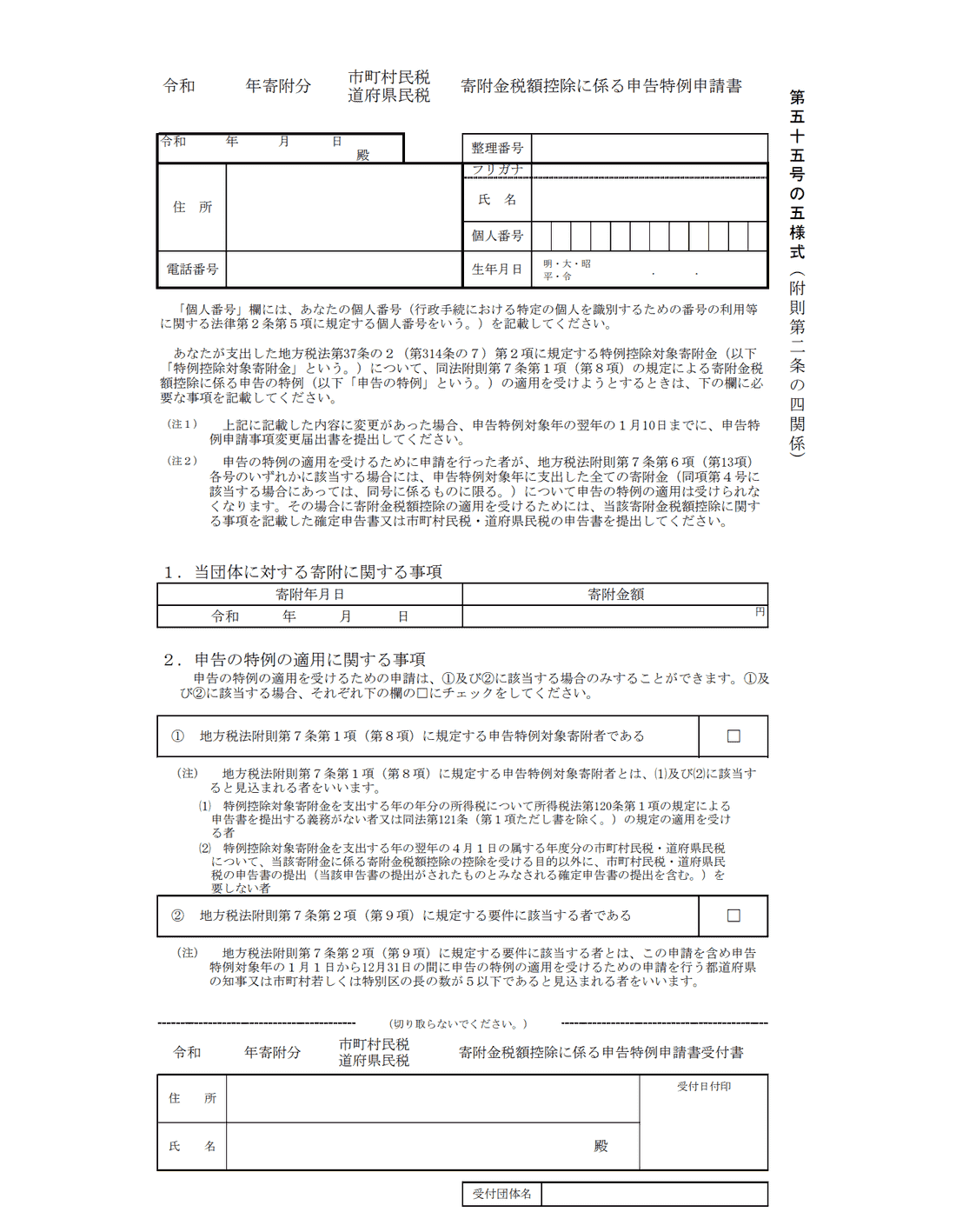
Sample of the official One-Stop Tax Exemption form (申告特例申請書) issued by each municipality. Source: Ministry of Internal Affairs and Communications (Soumusho) — official PDF. You'll receive a pre-printed form by mail from each municipality you donated to. The fields to fill in are name, address, phone, My Number (個人番号), date of birth, and the donation date + amount in the "1. 当団体に対する寄附に関する事項" section. Tick boxes ① and ② in section 2 if you're an employee whose income is fully reported via gensen choshu hyo and you've donated to 5 or fewer municipalities for the year.
Step 5b (tax return path): Include in your kakutei shinkoku. When you file your annual tax return (February-March), enter the donation amounts in the "寄附金控除" (donation deduction) section and attach the receipts. e-Tax allows electronic submission; paper filing is also accepted.
Step 6: Verify the credit applied. Around June of the following year, check your resident tax notification (or payslip). Your resident tax should be lower by approximately (donation - ¥2,000). If the credit didn't apply, contact your municipality — usually it's a missing One-Stop form or a kakutei shinkoku that didn't include the donation properly.
Required Documents
For the One-Stop path:
- Donation receipts from each municipality (mailed to you)
- One-Stop application form from each municipality (mailed to you)
- A copy of your My Number card (both sides) — or a copy of your My Number notification slip plus a copy of your residence card or other photo ID
- A return envelope (some municipalities provide pre-stamped envelopes; some require you to pay postage)
For the kakutei shinkoku path:
- All donation receipts from each municipality
- Your standard tax filing materials (gensen choshu hyo, etc.)
- My Number on the tax return itself
If you don't yet have a My Number card (only the notification slip), you can still participate — you just need to attach copies of both the notification slip and a photo ID. The notification slip is the temporary paper version most foreigners receive when they register their residence.
Considerations Specific to Foreign Residents
A few things that don't get explained well in Japanese-language guides:
You're eligible if you pay Japanese resident tax. Nationality doesn't matter — what matters is whether you're a tax resident of Japan with resident tax obligations. If you've been in Japan long enough to be paying resident tax (typically your second year as a resident, since resident tax is paid on prior-year income), you can participate.
Your first year in Japan is typically a no-go. Most new arrivals don't pay resident tax in their first calendar year (since the prior year wasn't a Japan resident year). No resident tax means nothing for Furusato Nozei to reduce. Wait until your second year to participate.
The "Reconstruction Surtax" complicates the math slightly. Japan still applies a 2.1% reconstruction surtax on income tax (originally from the 2011 earthquake, extended). This is included in the standard cap calculation but is one reason actual caps vary slightly from the published reference tables.
Multiple income sources change the cap. If you have rental income, side business income, or international income that's taxable in Japan, your cap calculation is more complex than the simple "salary plus dependents" model. Run a conservative estimate first, then consult a tax professional if amounts are material.
Returning home? Different rules. If you're planning to leave Japan within the year you donate, the resident tax credit logic still works (you'll pay resident tax for the year you were a Japan resident even after you leave). But the One-Stop path requires Japan residency on January 1 of the following year, so most leavers use the tax return path instead.
Does It Help Your FI Plan?
For most international residents, Furusato Nozei is mildly positive for your financial independence plan — but only if you choose your gift category carefully.
The unique question for FI is not "what's the gift worth?" but "does the gift replace spending you'd have done anyway?" If you choose Furusato Nozei rice and your household actually consumes rice continuously, the ~¥9,000 worth of rice you receive replaces ~¥9,000 of supermarket spending you'd have done regardless. That's real money staying in your account.
If you choose premium Wagyu beef as a treat — money you wouldn't normally spend on premium beef — the gift is enjoyable but doesn't replace any planned expense. The ¥9,000 of gift value is extra consumption, not FI value.
This distinction shows up as the replacement-percentage selector in the Furusato Nozei Simulator, under the optional "Want to see the FI impact?" section. A donation with 75%+ replacement (rice, daily goods, common protein) produces meaningful FI value — usually ¥500–¥3,000 per month in equivalent contribution. A donation with <25% replacement (luxury items you wouldn't otherwise buy) produces close to zero FI value, even though the tax math still works.
It's not a moral judgment. Treating yourself with a Furusato gift is a perfectly fine reason to participate — but recognize that the FI value depends on real spending replacement, not on the gift value alone.
For more on how FI planning specifically interacts with Japan's tax structure, see FIRE in Japan: NISA, Currency, and Retirement Planning and How Much of Your Japan Paycheck Can Actually Go Toward FI?.
Common Mistakes to Avoid
A few patterns that repeat across first-time donors:
Donating above your cap. The cap is income-dependent, and your income for the year isn't final until the year closes. Estimate conservatively — donating to 80% of your estimated cap leaves a buffer for income variance.
Missing the One-Stop deadline. January 10 sneaks up. If you wait until early January to mail your forms, postal delays can push you past the deadline. If you miss One-Stop, you can still claim via tax return — but you'll need to file kakutei shinkoku even if you wouldn't otherwise.
Donating to 6+ municipalities and assuming One-Stop still works. It doesn't. Over 5 municipalities, you must use the tax return path. Either consolidate into ≤5 municipalities, or accept that you'll file a return.
Forgetting to keep the receipts. Without the paper receipt from each municipality, your tax return claim is much harder. Some portals offer downloadable receipts as PDFs — save them as backup, but the paper version is the official document.
Assuming credit appeared but never checking. Look at your June resident tax notification to confirm the credit applied. If it didn't, you have time to follow up.
Using the Free Tools
PlanTogetherFI offers two free tools that together give you a complete picture for planning:
- Furusato Nozei Simulator — estimate your annual cap, see the Safe/Balanced/Max donation options, and (optionally) see the FI impact
- Japan Salary Tax Calculator — estimate your net take-home pay; the same income figure feeds your Furusato cap
Both use current reference values (NTA Reiwa 7+ for salary tax; Furusato Choice 2024–25 published table for the donation cap) and are intended for planning, not for filing. For tax filing, your gensen choshu hyo (year-end withholding slip) and a Japanese tax professional are your authoritative sources.
PlanTogetherFI is for educational planning only. It is not tax, financial, investment, or legal advice. Furusato Nozei rules and caps vary by income, deductions, family status, municipality, and year. For your specific situation, consult a qualified Japanese tax professional.
Final Thought
Furusato Nozei is one of the easier-to-use Japanese tax programs, but the user-facing simplicity hides some nuance: cap estimation, deadline discipline, and the question of whether the gift you choose actually fits your household. For most foreign residents who pay resident tax, the program is worth participating in — both for the tax math and for the way it points you toward regional Japan that you'd otherwise have less reason to engage with.
The financial impact is real but modest at typical income levels — usually a few hundred to a few thousand yen per month in net household value when you choose gift categories that replace existing spending. It's not transformative for your FI plan on its own, but it's a useful piece in the broader picture alongside NISA, iDeCo, and disciplined savings rate.
Frequently Asked Questions
Can foreigners in Japan use Furusato Nozei?
Yes, as long as you're a tax resident of Japan paying resident tax. Nationality is not a factor. Most foreign full-time employees become eligible in their second calendar year in Japan, since resident tax is calculated on prior-year income. Most major portals (Furusato Choice, Satofuru, Rakuten) have at least partial English support.
What's the maximum I can donate?
Your cap depends on your annual gross income, family structure (spouse and dependents), and other deductions like iDeCo or mortgage credits. For a single full-time employee in Tokyo earning ¥5M, the cap is around ¥61,000. Married households with one spouse-dependent and one child see roughly 25-30% lower caps at the same income. Use the Furusato Nozei Simulator for an estimate. Conservative strategy: donate to 80% of your estimated cap to leave room for income variance.
Is the ¥2,000 effective cost real?
Yes, if you stay within your cap. The donation is treated as a deduction against the following year's resident tax (with a small portion against income tax), and the net out-of-pocket cost is fixed at ¥2,000 regardless of donation size. Above the cap, the excess loses the tax credit entirely.
What's the difference between One-Stop and kakutei shinkoku?
One-Stop Tax Exemption is a simplified path for full-time employees donating to 5 or fewer municipalities. You mail a form to each municipality by January 10 of the year after donation; no tax return needed. Kakutei shinkoku is the standard tax return path, required if you donate to 6+ municipalities, are self-employed, have multiple income sources, or are filing a return for other reasons.
Do I need a My Number card?
Not necessarily a card — but you do need My Number documentation. For One-Stop, you attach either a copy of your My Number card (both sides), or a copy of your My Number notification slip plus a copy of a photo ID like your residence card. Most foreign residents who haven't yet obtained the card use the notification slip + residence card combination.
When does the tax credit actually appear?
Your resident tax bill for the year after your donation will be reduced by approximately (donation amount − ¥2,000). For employees, you'll see this reflected in your June payslip's resident tax line. For self-employed taxpayers, you'll see a smaller resident tax bill from your municipality starting in June.
Can I donate to my own municipality?
You can, but you don't get a return gift (the rules prohibit gifts from your own municipality of residence). The tax credit still applies. Most participants choose different municipalities specifically to enjoy the gift system.
What if I leave Japan before claiming?
The resident tax credit logic still works (you'll pay resident tax for the year you were a Japan resident even after you leave). But the One-Stop path requires Japan residency on January 1 of the year after donation, so most departing residents use the kakutei shinkoku path with their pre-departure tax filing instead. If you're planning to leave, talk to a tax professional familiar with cross-border situations.
Is Furusato Nozei worth it for high earners?
The cap scales with income — high earners can donate larger amounts at the same ¥2,000 effective cost. A ¥15M salary cap is roughly ¥395,000 for a single household. Whether it's worth your time depends on what you donate to: high replacement % categories (rice, common goods) produce real household value; low replacement % categories (luxury gifts) are mostly tax-credited consumption.